Skip to content
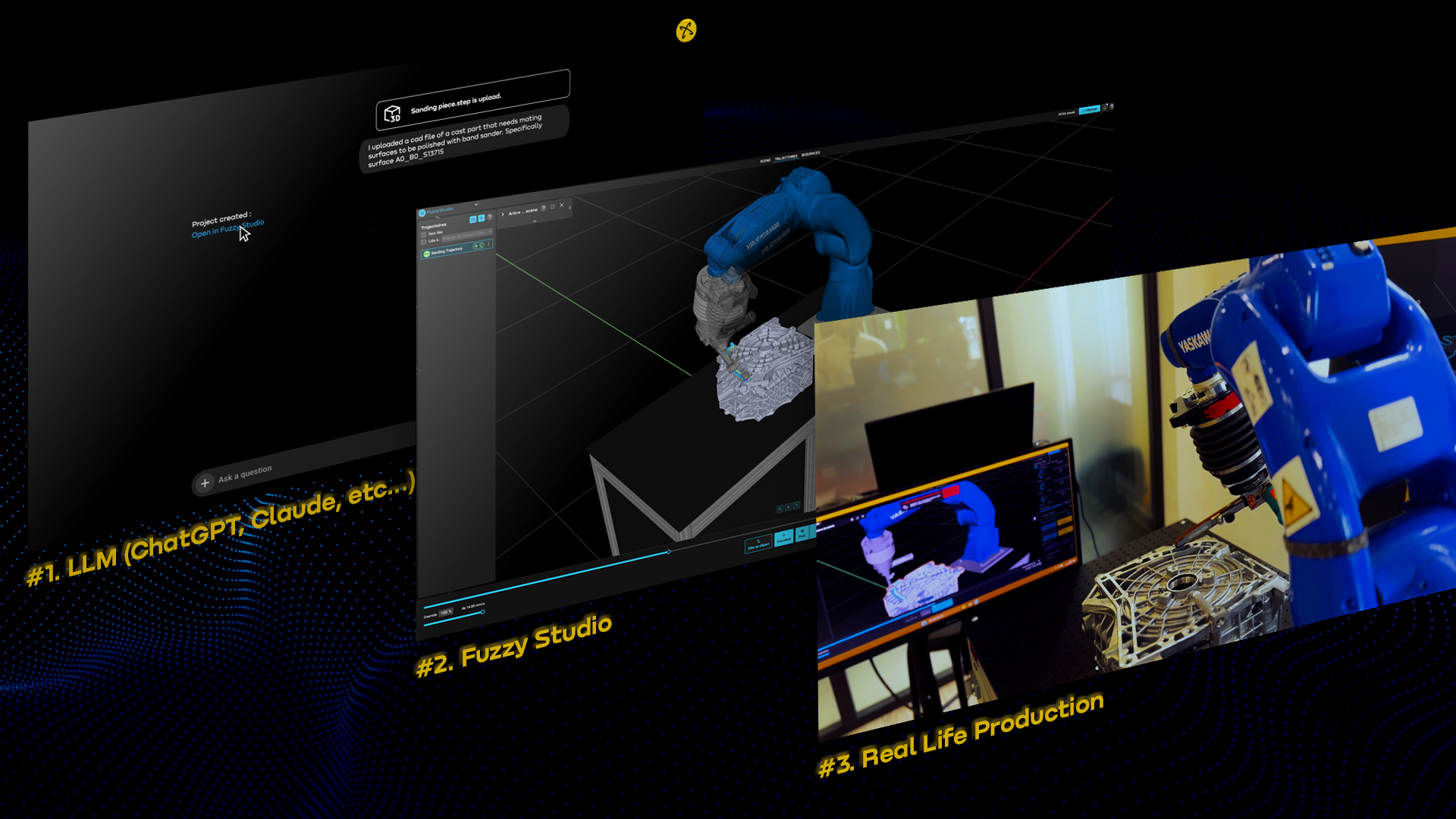
A scheme of Fuzzy MCP that create a 3D scene and trajectory in Fuzzy Studio and lauch production thanks to Fuzzy RTC

Private beta now forming

The first industry-ready robot control MCP for industrial and collaborative robots

Give AI agents a structured path from CAD and manufacturing intent to robot workcell creation, bounded motion,
factory integration, trajectory preview, and deterministic execution.

AI can reason. Robots need deterministic execution.

Large language models, VLA systems, and physical AI agents are becoming powerful enough to plan real-world tasks. But factories are not blank canvases. Industrial robots still require precise geometry, calibrated tools, valid trajectories, controller-specific execution, PLC coordination, safety equipment, operator procedures, and deployment discipline.

Fuzzy MCP Gateway bridges that gap. It lets AI systems propose and configure robot applications while Fuzzy Studio and Fuzzy RTC handle the industrial
robotics layer: CAD context, project structure, trajectory generation, motion constraints, driver state, preview, PLC-aware execution, and production runtime behavior.

From prompt to robot-ready Fuzzy Studio project 

With Fuzzy MCP Gateway, a developer can connect an AI agent to a Fuzzy robotics workflow and ask it to create
useful industrial robot applications.


Fuzzy MCP scheme explain that Fuzzy MCP connect to Fuzzy Studio to create the 3D scene and Fuzzy Studio connect to Fuzzy RTC to launch production


An AI interface for a real robotics stack 

Fuzzy MCP Gateway is designed around two existing Fuzzy Logic Robotics technologies:

RTOS-1

Fuzzy RealTimeControl

The real-time control layer that abstracts industrial and collaborative robot brands behind a common runtime, trajectory system, state interface, execution API, and industrial integration layer.

FS-glyph_blue

Fuzzy Studio

The visual environment for CAD, workcell configuration, robot projects, tools, TCPs, trajectories, and application preview.


Together, they create a practical boundary for physical AI:

FS-glyph_white

Fuzzy Studio

Provides visual understanding and project authoring.
Logo white Real Time Control - Glyph

Fuzzy RTC

Provides deterministic robot execution and real-time motion constraints.
Logo MCP-2

Fuzzy MCP Gateway

Provides the standard interface for AI agents.

Expose robot applications as tools, resources, and workflows

MCP gives AI clients a standard way to work with external systems. Fuzzy MCP Gateway turns robotics capabilities
into structured tools and resources.

Possible resources:

FS-glyph_white

Active Fuzzy Studio project

BookOpened

Scene graph

CAD-1

CAD-derived part context

Robot

Robot and controller configuration

RobotTool

Tool and TCP definitions

FlagReady

Driver state

Trajectory state

Preview-1

Path previews

WaypointList

Logs and runtime status

Possible tools:

Primitives

Import a CAD part

WorkPiece

Analyze part geometry

FS-glyph_white

Create a Fuzzy Studio project

Robot

Add a robot to the cell

ReferenceFrame

Define a tool and TCP

Generate

Generate a sanding path

Waypoint

Create trajectory waypoints

Preview-1

Preview a trajectory

Sphere

Validate reachability

Approach

Request simulation

Robot-1

Request robot execution

Turn AI intent into bounded robot motion

Physical AI needs access to robot systems, but factory deployment requires more than direct model-to-motion control.
 
Fuzzy MCP Gateway is designed so AI systems can work at the right level for the task. They can propose a workcell, generate a trajectory request, inspect state, and ask for execution. When real-time motion streaming is needed, Fuzzy RTC can enforce the robot-aware envelope: joint limits, velocity limits, workspace boundaries, tool orientation rules, keep-out zones, collision constraints, watchdog behavior, and process limits.
 

Key principles:

● No uncontrolled prompt-to-servo execution

● Deterministic runtime execution through Fuzzy RTC

● Permissioned tools by risk level

● Task-level commands for CAD, cells, tools, trajectories, and sequences

● Approval gates available when the cell policy requires them

● Simulation and preview where appropriate

● Bounded streaming for real-time motion intent

● PLC, safety equipment, and operator workflow compatibility

● Permissioned tools by risk level

Built for developers bringing AI into the physical world

 The beta is designed for teams building:  
 

Physical AI applications

Bridge the gap between digital intelligence and physical execution. Deploy multi-modal AI agents capable of interacting with complex, unstructured factory environments safely. 

Robotic foundation models

Fine-tune and test your foundational models on production-grade robotics hardware. Validate spatial reasoning and task planning against real-world physical constraints. 

Vision-language-action systems

Translate visual inputs and natural language tokens into safe, deterministic robot trajectories. Seamlessly integrate VLM pipelines with real-time industrial control. 

AI robot copilots

Empower operators with intelligent shop-floor assistants. Enable real-time voice or text-driven task modification with full workspace safety enforcement. 

Industrial robot programming tools

Build next-generation no-code or low-code industrial frameworks. Expose complex kinematics solvers and path-planning modules through a simple, standardized API layer.

CAD-to-robot workflows

Automate feature extraction and toolpath generation directly from 3D assets. Let your AI agents interpret geometry constraints and generate ready-to-execute paths. 

AI-assisted manufacturing automation

Optimize high-mix production cycles using adaptive reinforcement learning. Dynamically adjust process parameters for welding, grinding, or assembly on the fly. 

Simulation-to-real robot workflows

Eliminate the Sim2Real gap. Safely transition policies trained in digital twins to real robot cells using FuzzyMCP’s deterministic safety boundaries.


 Ideal beta participants:  


AI robotics startups

Physical AI scale-ups

Robotics research teams

Advanced system integrators

Manufacturing innovation labs

Industrial automation software teams

FAQ (Frequently Asked Questions)

Is this a robot safety system?

No. Fuzzy MCP Gateway is intended to provide a structured AI interface to Fuzzy Studio and Fuzzy RTC. It does not replace certified safety systems, robot safety controllers, risk assessments, guarding, or operator procedures. Its role is to make AI-driven robotics compatible with those industrial realities, not to replace them.

Does the AI directly control robot motion?

Not by default. The intended architecture supports task-level commands such as creating workcells, generating trajectories, validating motion, and executing sequences. Where streaming motion intent is useful, Fuzzy RTC should enforce the robot-aware constraints before commands reach the robot.

Can it work with real robots?

Yes, that is the point. The goal is to support simulation, preview, bounded motion streaming, trajectory execution, and real robot deployment through Fuzzy RTC, while fitting into existing factory automation architectures.

How does this fit with PLCs and factory safety systems?

Fuzzy MCP Gateway should be designed to work alongside PLCs, safety-rated equipment, robot controllers, cell controllers, and operator procedures. MCP is the AI interface. Fuzzy Studio and Fuzzy RTC translate that intent into industrial robot workflows that can be coordinated with the rest of the cell.

Which AI clients will it support?

The goal is to support MCP-compatible clients and custom AI applications. Examples may include developer tools, agent frameworks, and AI assistants that support MCP.

What is the first demo?

The first proposed demo is CAD to deburring: upload a CAD part, generate a Fuzzy Studio workcell, create a deburring trajectory, preview it, and request execution.

Who should apply?

AI developers, physical AI teams, robotics startups, research groups, and industrial automation teams looking for agent-ready industrial robot workflows.